Carbon Monoxide Alarms and Oil Boilers: What the Rules Say
By Advanced Oil Boiler Services · Published
Carbon monoxide comes from fuel that is not burning completely, and oil is one of those fuels. OFTEC, the body that registers oil heating technicians, lists oil alongside gas, LPG, wood and coal as fuels that can produce it.
The rules on carbon monoxide alarms changed in 2022 to cover oil appliances properly, and they are often misunderstood. Here's what applies, depending on whether you're having a new boiler fitted or you rent the home out.
When you have a new or replacement oil boiler fitted
In England, the building regulations guidance for heating appliances, Approved Document J, says: "Where a new or replacement fixed oil burning appliance is installed in a dwelling, a carbon monoxide alarm should be provided in the room where the appliance is located." This came in with the 2022 amendments, which took effect on 1 October 2022.
Which alarm, and where it goes
Approved Document J says the alarm should meet BS EN 50291-1:2018 and run on a battery designed to last the working life of the alarm, with a warning that tells you when that working life is coming to an end. A mains-powered alarm is also acceptable if it is a Type A model with fixed wiring (not a plug-in) and has a sensor failure warning.
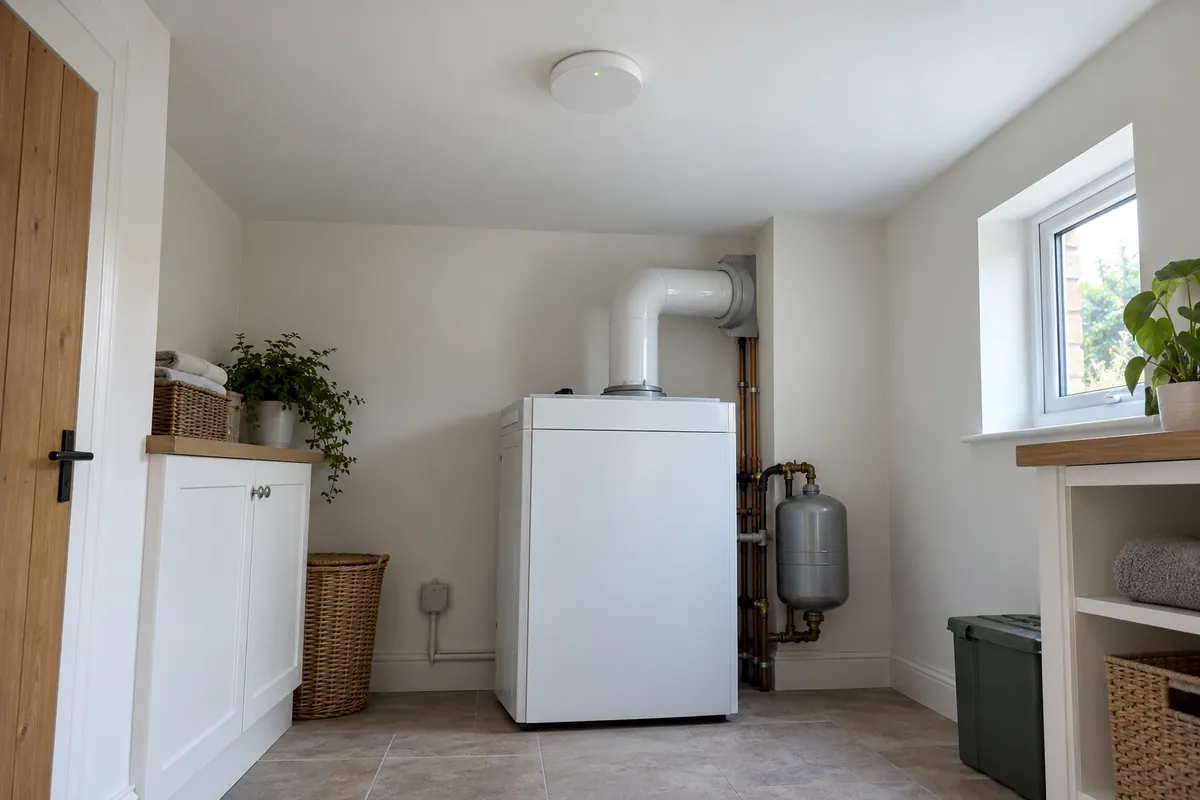
- Fit it in the same room as the boiler.
- On the ceiling, keep it at least 300mm from any wall.
- On a wall, fit it as high as possible, above any doors and windows, but not within 150mm of the ceiling.
- Keep it between 1m and 3m horizontally from the boiler.
If you rent the home out
- England: since 1 October 2022, landlords must make sure a carbon monoxide alarm is fitted in any room used wholly or partly as living accommodation that contains a fixed combustion appliance (gas cookers are excluded). They must check it works on the day a new tenancy begins, and repair or replace it if a tenant reports a fault.
- Wales: landlords must make sure there is a working carbon monoxide alarm in each room that contains a gas appliance, an oil-fired combustion appliance or a solid fuel burning appliance.
- Scotland: since 1 February 2022, the tolerable standard, which applies to all homes, includes satisfactory equipment for detecting and warning of carbon monoxide.
- Northern Ireland: private landlords have had carbon monoxide alarm duties since 1 September 2024 for new tenancies and 1 December 2024 for all others, including checking alarms at the start of every tenancy and replacing them when faulty or past their expiry date.
An alarm is not a substitute for servicing
Approved Document J is clear that a carbon monoxide alarm "should not be regarded as a substitute for the correct installation and regular servicing" of a boiler. OFTEC explains that carbon monoxide usually only occurs if there is a fault with the appliance or not enough air for the fuel to burn, and that poor servicing, incorrect installation or missing air vents can cause it. Its advice is to have the appliance serviced at least once a year by a suitably qualified technician.
If your carbon monoxide alarm goes off
OFTEC's advice is:
- Open doors and windows straight away to ventilate the area.
- Switch off all fuel burning appliances.
- Leave the building straight away, and do not go back in until it is safe.
- Do not use the appliance again until a competent technician has checked it and confirmed it is safe.
- If you have symptoms of carbon monoxide poisoning, such as headaches, dizziness, nausea, tiredness or breathlessness, contact your GP or go to A&E.
A yearly service by an OFTEC registered engineer, across Watford, Hertfordshire and surrounding areas.
Related advice
Sources
Checked 8 October 2026.
- Approved Document J: Combustion appliances and fuel storage systems (2022), paragraphs 4.30 to 4.32
- GOV.UK: Approved Document J, 2022 amendments in effect from 1 October 2022
- OFTEC: carbon monoxide safety
- Smoke and Carbon Monoxide Alarm (England) Regulations 2015, regulation 4
- Renting Homes (Fitness for Human Habitation) (Wales) Regulations 2022
- Housing (Scotland) Act 1987, section 86 (tolerable standard)
- Smoke, Heat and Carbon Monoxide Alarms for Private Tenancies Regulations (Northern Ireland) 2024